
Leaving Do Photo Collection: One Album, Every Memory, From Everyone
The simplest way to gather photos and messages from the whole team, including remote colleagues, into a single keepsake your leaving colleague will keep long after they have forgotten where they left the leaving card.
Create a free Pix album, share a QR code or link with the team, and everyone uploads their photos and messages in their own time. No WhatsApp threads, no Google Drive folders, no chasing people for files. The album is ready to present on the day.
Create a Free Leaving Do AlbumTL;DR: How to collect photos for a leaving do
Create a free shared photo album (Pix works well), share the link or QR code with the team 10 to 14 days before the leaving date, ask colleagues to upload old team photos and throwbacks, then display the QR code at the leaving do itself so everyone can add photos on the night. Close the album 48 hours after the party and present the link, plus optionally a printed photo book, as the leaving gift.
The Timeline: What to Do and When
The biggest mistake people make with leaving do photo collections is starting too late. Here is a realistic timeline that works for teams of 10 to 100, hybrid or in-office.
Create the album (5 minutes)
Go to pix.wedding, create a free event called "[Name]'s Leaving Do", and get a QR code and shareable link instantly. No account needed for contributors.
Send the link 10 to 14 days before the leaving date
Share the link in Slack, Teams, or email with a short message (see the template below). Give everyone, including part-time and remote colleagues, enough time to dig out old photos.
Print or display the QR code on the day
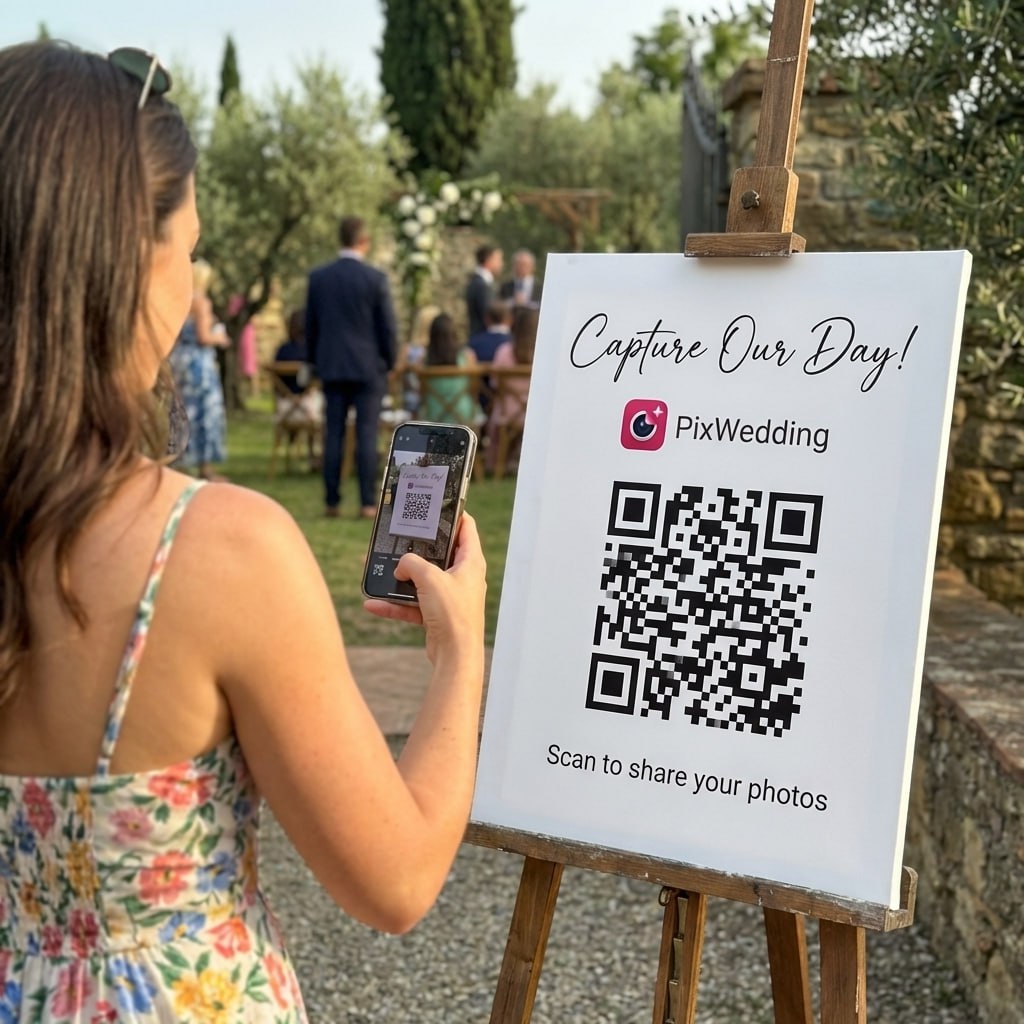
Print the QR code on the leaving card, a table tent, or a banner at the venue. Colleagues scan it throughout the evening and upload photos as they take them.
Send a reminder 48 hours before the do
A brief nudge in the team channel gets stragglers to upload before the day. Mention you are also collecting photos from the party itself so people know to keep uploading after the event.
Close the album 48 to 72 hours after the party
This gives people time to upload photos taken on the night. Announce a clear deadline so you can compile the final keepsake and present it before the person actually leaves.
Present the album link (and optionally a printed book)
Share the album link as the leaving gift, ideally printed on a card with a QR code. Download the full-resolution photos and order a photo book from Photobox or Papier as a physical companion if budget allows.
Copy-and-Paste Message Template
Getting colleagues to actually contribute is 90% about how you ask. A vague "can everyone send me their photos?" gets ignored. A specific request with a link and a deadline gets results. Use this template in Slack, Teams, or email:
48-hour reminder template

Last day photo
We'll miss you!
One QR Code. Every Photo From the Leaving Do.
Create a free Pix album in two minutes. The whole team, including remote colleagues, can upload photos and messages without downloading an app or making an account.

From the team
Scan to join the album
No app, no account
UPLOADING
Saving your moment
THE ALBUM
Emma & Jack
June 21, 2026
647 photos · 95 guests







SCAN TO TRY
pix.wedding/
your-wedding
Pix vs Kudoboard vs Thankbox vs GroupTogether vs Google Photos vs Eventoly vs Illume
Seven tools come up repeatedly when UK teams search for leaving do collection options. They split into three categories: photo-first albums (Pix, Google Photos, Eventoly), message-card platforms with optional photo support (Kudoboard, Thankbox, GroupTogether, Illume), and audio-focused tools (Eventoly also records voice notes and audio guestbook messages). Here is how they compare on the things that actually matter for a leaving do keepsake.
| Feature | PixRecommended | Kudoboard | Thankbox | GroupTogether | Google Photos (shared album) | Eventoly | Illume |
|---|---|---|---|---|---|---|---|
| Type | QR photo album | Digital group card / message board | Digital group card + gift pot | Group card + gift money pool | Shared photo album | Photo + video + audio guestbook | Collaborative group card |
| Cost to organiser | Free for all contributors | Lite: up to 20 posts for $5.99 (one-off) | Free to set up; £4.99 to send | Card is £5.50 standalone; free if you collect money | Free | One-time from ~$49 (organiser pays) | Free to create; paid premium options |
| Photo quality | Full resolution | Photos and GIFs supported; no resolution detail published | Photos, GIFs, video messages; no compression info published | Photos and GIFs; no video | Full resolution | Full resolution, unlimited uploads | Photos and GIFs supported |
| Video support | Yes | Premium tier and above ($8.99+) | Yes (video messages) | No | Yes | Yes | No (GIFs supported) |
| Written messages | Yes, per photo and album-level | Yes (primary feature) | Unlimited | Unlimited | Comments only | Yes, voice notes and audio guestbook | Yes, unlimited contributors |
| Remote colleagues | Yes, link or QR code | Yes | Yes | Yes | Yes (Google account required) | Yes, QR code or link, no app or login needed | Yes |
| Printable / downloadable | Yes, download all | Premium tier and above ($8.99+) | Download as PDF | Download as PDF | Yes | Yes, download all | Download as PDF (premium) |
| Gift money collection | No (photo keepsake focus) | Via partner gift cards | Yes, built-in collection pot | Yes, collect money for eGift cards | No | No | Yes, gift-card pooling |
| Best for | Complete photo + message keepsake | Message-focused boards; enterprises on team plans | Messages + gift collection in one; UK teams | Pooling money + a simple group card | Photo storage; no keepsake framing | Photo + video + voice keepsake; audio farewell messages | Message-card-first; group cards with photos and gift pooling |
Pricing verified June 2026. Kudoboard is billed per board in USD; the Lite tier caps posts at 20, which fills quickly on a whole-team leaving do. Thankbox and GroupTogether both charge the organiser a small fee (around £4.99 to £5.50) rather than charging contributors. Google Photos requires every contributor to have a Google account, which creates friction for contractors and external contacts. Eventoly pricing is in USD and is a one-time organiser charge with no per-contributor fees; storage is included for up to 12 months. Illume is free to start with optional paid upgrades for additional features.
A note on Eversnap
Eversnap was one of the original event photo-sharing apps and is still mentioned in older round-up articles. It was acquired by Snappr and is winding down: the service cannot take on new events after late August 2026, and existing customers are being refunded. If you have seen Eversnap recommended elsewhere, it is no longer a safe choice for a leaving do collection. Use one of the active alternatives in the table above instead.
What Group Card Platforms Actually Offer (and Where They Fall Short)
Group card tools are worth understanding properly before you commit. Each has a different model: some charge the organiser, some have contributor caps, and none of them are primarily photo tools. Here is an honest breakdown of the three you will encounter most often, based on their published pricing as of June 2026.
Kudoboard
Digital message board with photos and GIFs
Kudoboard sells individual boards one at a time rather than a subscription. The Lite board costs $5.99 and caps contributors at around 20 posts total. That fills surprisingly quickly when a whole team contributes messages, photos, and GIFs: six people each adding three posts will hit the ceiling. The Premium board ($8.99) raises the cap to 100 posts and adds video upload and a download feature. The Milestone board ($19.99) removes the cap entirely and suits large departments or all-hands farewells.
The key limitation for a leaving do specifically is that Kudoboard is primarily a message board, not a photo album. Contributors can attach a photo to a message post, but there is no dedicated gallery view or bulk photo download. If the goal is a rich photo keepsake from the night itself, Kudoboard works less well than tools designed around photography.
Thankbox
Digital group card with built-in gift collection
Thankbox is the most UK-oriented of the group card platforms. A Classic Thankbox costs £4.99 to send (the organiser pays, not contributors), and that single fee covers unlimited contributors, unlimited messages, photos, GIFs, and video messages. There is no post cap. You can set up the card for free and only pay when you are ready to send it, which is a sensible model when you are not sure how many people will contribute.
The built-in collection pot is a genuine convenience for leaving dos: colleagues can write a message and chip into a gift fund at the same time, in a single click. The recipient can spend the pot on digital gift cards from over 1,000 retailers or on UK-specific gifts including Bloom and Wild flowers and hampers. What Thankbox does not provide is a proper photo album: photos appear inside individual message posts, not in a gallery. It is a card that happens to hold photos, not a photo collection tool.
GroupTogether
Group gift money collection with a card attached
GroupTogether's core product is a money-pooling tool for group gifts. The card is secondary. A standalone farewell card costs $5.50 AUD; it becomes free if you are also collecting money for a gift and the total reaches $20 AUD or more. Contributors pay a small processing fee (1.5% plus $0.10 for card payments; 2.3% plus $0.30 for PayPal). The card itself supports unlimited messages, photos, and GIFs but does not support video. There is no bulk photo download. The platform does not publish photo quality or size limits.
GroupTogether suits the situation where collecting money for a leaving gift is the primary goal and the card is a nice addition. It is not suited to the situation where the photo collection is the gift itself.
Eventoly
Photo, video, and audio guestbook platform
Eventoly is not a message-card tool. It collects an actual photo and video gallery alongside a voice note or audio guestbook layer, which makes it meaningfully different from Kudoboard or Thankbox. Guests upload without downloading an app or creating a login: they scan a QR code or tap a link and go straight to uploading. There is no cap on uploads, and storage is included for up to 12 months. The organiser pays a one-time fee starting at around $49 USD, with no recurring charge and no contributor fees.
The audio guestbook feature is particularly suited to leaving dos. Colleagues who struggle to write a heartfelt message can record a short voice note instead, and those voice notes are stored alongside the photos. For a senior leaver or a long-serving colleague, that combination of photos, videos, and recorded voices can produce something considerably more emotional than a PDF card.
Events are private by default, which matters for corporate settings where you may not want colleagues' photos visible beyond the team. The platform is US-based and priced in USD, so UK teams should factor in the exchange rate. It does not offer gift pooling, but it is the strongest alternative for teams where the photo and video keepsake, with voice, is the goal.
Illume
Collaborative group card with photo and gift pooling
Illume is a well-known group-card platform that positions itself on collaborative warmth: the card is designed to feel like a shared creative effort rather than a bulletin board of separate posts. Contributors can add text messages, photos, and GIFs, and there is no cap on the number of contributors on the free tier, which makes it more accessible than Kudoboard's Lite tier for larger teams.
The free version is genuinely usable: you can create a card, collect contributions from unlimited colleagues, and send it without paying anything. Paid premium options unlock features such as PDF download, additional design themes, and access to the gift-card pooling function, where colleagues can chip in towards a gift card alongside their message. The platform does not support video uploads, only photos and GIFs.
Like Kudoboard and Thankbox, Illume is message-card-first: photos appear as attachments within individual posts rather than as a standalone gallery. If the team wants both a heartfelt group card and a gift collection in one tool and does not need a photo album specifically, Illume competes directly with Thankbox. If the photo keepsake is the primary goal, a dedicated photo tool is still the better choice.
The key distinction: Kudoboard, Thankbox, GroupTogether, and Illume are all message-card platforms where photos are one type of post among many. None of them produce a downloadable photo gallery. Eventoly collects photos, videos, and voice notes in a single album and is the strongest alternative for teams where the media keepsake is the gift. If the leaving gift is a photo collection, use a dedicated photo-sharing tool alongside or instead of a group card, then download the full-resolution images to print a photo book separately.
10 Types of Throwback Photos to Ask For
People default to uploading the most recent photos they have. Nudge them to dig further back with specific prompts. These are the photo types that make a leaving album genuinely emotional rather than just a collection of drinks at a pub.
6 Mistakes That Kill the Leaving Do Photo Collection
Most leaving do photo collections end up with fewer contributions than expected, not because people do not care, but because the organiser hit one of these avoidable pitfalls.
Starting the day before the leaving do
Last-minute requests produce three photos from the person who sits nearest the organiser. Start at least 10 days out.
Forgetting remote and part-time colleagues
They rarely hear about the leaving do collection until too late. Email them directly rather than relying on a Teams announcement.
Using a WhatsApp group for collection
Images get compressed, the thread fills up, and you spend an evening downloading 47 files to your camera roll. A dedicated album tool avoids this entirely.
Only collecting photos from the leaving do itself
The party photos are great but the throwbacks, team days, funny Zoom backgrounds, office birthdays, are what make the keepsake genuinely emotional.
Sharing the album with the leaving colleague too early
Keep the link private until you are ready to present it. Discovering your own leaving gift before the day deflates the moment completely.
No written messages in the collection
Photos without context age oddly. A short caption or message per photo, or a message section in the album, gives the keepsake an emotional throughline.
Turning the Album Into a Printed Photo Book
A digital album is permanent and instantly shareable, but some colleagues prefer something physical to put on a shelf. The two options work well together: the digital Pix album as the main gift (presented on the day), and a printed photo book ordered in the week after, once you have all the post-party uploads.
Photobox
UK-based, prints arrive in 3-5 working days. Square formats work well for a mix of portrait and landscape photos. From around £15 for a softback.
Snapfish
Frequently discounted, good for larger teams wanting to split the cost. Lay-flat photo books keep double-page spreads looking clean.
Papier
Premium finish, better suited to a small curated selection of photos rather than a 100-photo dump. Good for senior leavers where quality signals matter.
Boots Photo
Collect in store the same day in some cases. Useful if you are running up against a tight deadline before someone leaves.
Tip: Download all photos from your Pix album after the collection closes. Photos are stored at full resolution, so they print cleanly at A5 or A4 without pixelation. Avoid printing directly from WhatsApp or Slack exports as those are compressed and look muddy in print.
How to Include Remote Colleagues in a Leaving Do Photo Collection
Hybrid and remote teams are now the norm in UK workplaces. The risk with leaving do photo collections is that remote colleagues, who often had the closest working relationships with the person leaving, end up with nothing to show for it because they could not be there in person. Here is how to fix that.
Email them directly, do not rely on Slack
Remote colleagues often have Slack notifications turned down or check the team channel less frequently. A direct email with the album link and deadline gets a much higher response rate.
Ask specifically for video call screenshots
Remote colleagues have archives of video call screenshots, shared screen moments, and digital collaboration snapshots that are just as valid as in-office photos.
Get one remote colleague to coordinate others
If the leaver had a close remote colleague, ask them to champion the collection in that office or time zone. Peer-to-peer nudges outperform top-down requests.
Host a separate remote leaving call
A 20-minute video call on the day where remote team members can say goodbye live. Screenshot the call and add it to the album so it is documented alongside the in-person party photos.
Getting a Group Message From Everyone, Not Just the Loudest Voices
A leaving do photo collection is more powerful with a short message per contributor. The challenge is that people go blank when asked to write something. Give them a prompt and you will get genuine responses rather than "Good luck, you'll be missed."
What is your favourite memory of working with [Name]?
What did [Name] teach you that you will actually use?
Describe [Name] in three words
What project are you most glad you worked on together?
What will the team notice most when [Name] is gone?
What do you want [Name] to know before they go?
Add a message prompt to the team message template
When you share the album link with the team, include one specific prompt in the message. Something like "When you upload a photo, add a short caption: what is your favourite memory with [Name]?" dramatically increases the quality and quantity of written contributions. People respond to a specific question much better than an open "feel free to add a message".
Using a QR Code on the Night
A QR code at the leaving do itself is the most effective way to capture photos taken on the night. People are already on their phones; a QR code removes the extra step of finding a link or typing in a URL. Here is how to do it properly.
Print it on the leaving card
The person presenting the card to the leaver can mention the QR code directly. It connects the physical card moment to the digital album.
Table tent or A5 printout at the venue
A laminated A5 card on each table at the pub or restaurant with "Scan to add your photos to [Name]'s leaving album" prompts people mid-conversation.
Pin it in the team Slack during the evening
For hybrid events where some people join remotely, drop the link in the team channel during the party so remote colleagues can follow along and upload simultaneously.
Mention it in the speeches
If there are toasts or a short speech, the speaker can mention the album and ask everyone to scan the code and upload a photo at the end of the evening.
Related Guides
Why a Photo Collection Beats a Standard Leaving Card
A leaving card gets read once and tucked in a drawer. A photo collection gets revisited on a quiet Sunday evening years later, when a former colleague wants to remember the team that shaped them. That difference in longevity is why photo albums have overtaken group cards as the default leaving do gift in UK workplaces.
The practical challenge has always been coordination. Getting 20 people to contribute to anything, especially across hybrid or remote teams, requires a system that removes friction. The best solutions let colleagues upload in their own time, without needing an app install or a login, by simply scanning a QR code or tapping a link.
Group card platforms such as Thankbox (£4.99 to send) and Kudoboard ($5.99 to $19.99 per board in USD) solve the coordination problem well for written messages, but they are not designed around photos. Photos in those tools appear as attachments to individual message posts; there is no photo gallery, no bulk download, and no way to present a full-resolution image collection as the centrepiece of the gift. If the photo album is the gift, a dedicated photo-sharing tool is the right choice.
Pix was built originally for wedding guests but the core mechanic, one QR code, everyone uploads, one organised album, translates perfectly to leaving dos. There is no charge for contributors, no storage cap on a free trial, and the album link stays active so the leaving colleague can revisit it any time.
- •Colleagues keep the memories even after leaving the company email behind
- •Remote and hybrid team members can contribute from anywhere
- •Full-resolution photos are downloadable for printing later
- •No chasing individuals for files across email and WhatsApp
- •The album doubles as a time capsule of team culture
What Makes a Good Leaving Do Photo Keepsake
The best leaving do photo collections mix three things: photos from the party itself, throwback photos from throughout the colleague's time at the company, and short written messages from the team. That combination turns a photo dump into something genuinely emotional to receive.
Quantity matters less than variety. A collection of 40 photos spanning someone's career, including a snap from their first week, a team day out, a random Tuesday lunch, and the leaving do itself, tells a richer story than 80 photos from the party alone. Ask contributors to dig back through their camera rolls when they upload.
Written messages inside the album add the personal dimension that a photo alone cannot. Platforms that combine photos and text in one place, rather than a card plus a separate Google Drive folder, produce keepsakes that hold together as a coherent gift.
Leaving Do Photo Collection: Common Questions
Everything you need to know about our free tools and how they help your wedding day.
The easiest method is a shared QR code album. Print or display a QR code at the event; colleagues scan it and upload photos directly from their phones. Everything lands in one place automatically with no email chains or WhatsApp groups required. Tools like Pix let you set one up in under two minutes.
Share a link to the photo album via your team Slack, email, or WhatsApp group at least a week before the leaving do. Remote colleagues can upload photos from past team days, video call screenshots, or any shared memories directly from their phones or laptops without needing to attend in person.
Both. Ask colleagues to upload old team memories and photos beforehand so the album already has content on the day. Keep the album open for 48 to 72 hours after the event so people can upload photos taken at the party itself. Set a clear deadline so you can compile the final keepsake in time.
Kudoboard is a digital group message board where colleagues add text, GIFs, and photos to a shared canvas. It is not free: the organiser pays per board in USD, starting at $5.99 for the Lite tier which caps contributors at around 20 posts in total. The Premium tier ($8.99) raises that to 100 posts and adds video upload. There is no bulk photo gallery or photo download on the lower tiers. Pix creates a dedicated photo album where photos are the primary content, all at full resolution and downloadable as a batch. Thankbox (£4.99, UK focused) and GroupTogether are closer alternatives to Kudoboard: they are also message-card tools that happen to accept photo attachments, but none of them produce a photo gallery keepsake.
Yes. Once the album is complete, you can download all the photos from Pix in full resolution and upload them to a photo book service such as Photobox, Snapfish, or Papier. Many teams do this as a secondary gift alongside the digital album so the colleague has both a permanent online keepsake and a physical copy.
Start one to two weeks before the leaving date. This gives the whole team, including remote and part-time colleagues, enough time to contribute without leaving anyone out. Send a reminder three days before the do and a final nudge the morning of the event. Close the album 48 hours after the party so you have everything before you present the gift.