
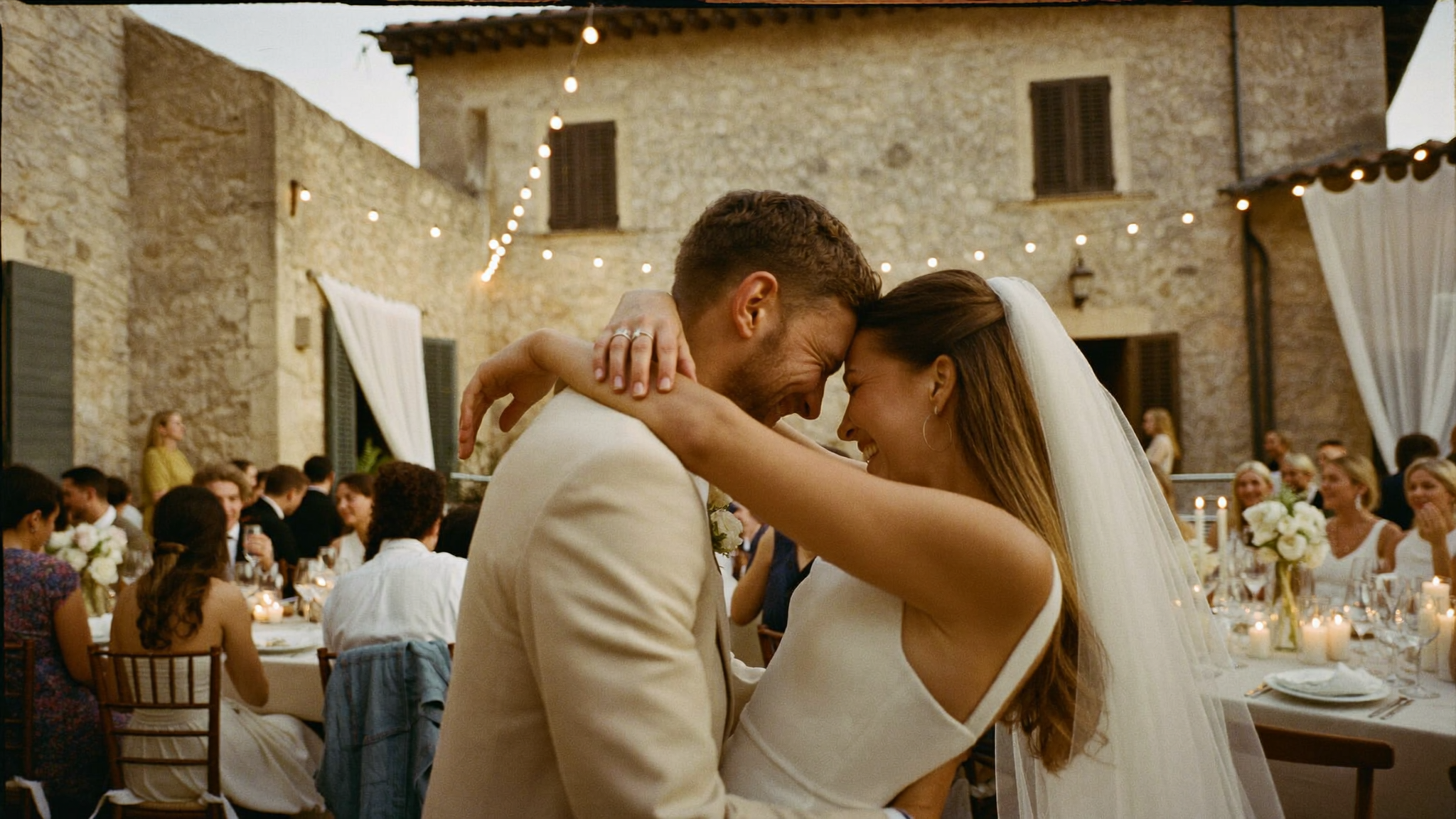
You will not know it is the photo until later. Sometime months after the wedding, you will sit down with the album. You will be looking for something specific. A face. A second. Your father's face during the toast, or your partner's during the vows, or your grandmother's hand resting on your shoulder before you walked down the aisle. You will scroll, and you will scroll, and it will not be in there.
Almost every couple who writes to us months after their wedding writes about this same kind of moment. Different faces, different rooms, different weddings. The same gap. We hear it often enough, and we have read enough of these letters compiled in pieces like our roundup of the most common wedding photo regrets, that we are writing this now, before yours, because the gap is preventable. It just has to be prevented while there is still time.
This letter is for one person. The person still planning. The one reading this somewhere between booking the venue and finishing the seating chart, who has not yet thought about the photo she will look for and not find. We want you to think about it now, while it is still a thing you can change.
We are not going to pretend this is a universal law of weddings. Some couples sit down with the gallery and find every face they hoped for, because a relative happened to be a good photographer, or the professional coverage happened to catch it, or luck simply ran their way. We are writing about the far more common version of the story, the one where nobody was pointed at the right person at the right second, and the photo simply never came into existence. That version is not about luck. It is about whether a plan existed for the parts of the day the hired camera could not reach.
There is no way to know in advance which version your wedding will be. That uncertainty is precisely the argument for planning for the second version anyway. If it turns out you did not need it, nothing was lost, a QR card sat on a table and mostly duplicated what the photographer already caught. If it turns out you did need it, the difference is between having the photo and not, permanently.
You will not go looking for the photo you posed for. You will go looking for the one nobody planned.
The moment that will not be in your gallery
It is usually a single moment, less than a second long, on someone's face. A father's, mid-toast. A partner's, during the vows. A grandmother's, at the table, when she thinks no one is looking. It is rarely the moment anyone was told to pose for. It is the one that happened while everyone's attention, including the photographer's, was pointed somewhere else.
Ask a couple who has been married a year or two what they wish they had, and the answer is almost never "more formal portraits." It is a specific, small, unplanned thing. That specificity is the whole point. A generic wish, "I wish we had more photos," is easy to shrug off. A precise one, "I wish I had a photo of my dad's face during my vows," is the kind of thing that sits with you.
Picture it, purely as an illustration and not a real couple: a father standing at the edge of the dance floor, arms crossed, doing the thing where he presses his mouth into a flat line because his eyes are doing something else entirely. Nobody says "picture" in that moment. Nobody points a lens at him. If a guest two tables over happened to have their phone up, that face exists somewhere. If not, it never did, as far as any photo can prove.
Or picture a different, equally illustrative scene: a grandmother at a corner table, half turned toward the dance floor, laughing at something her granddaughter said a second earlier. Nobody staged that. Nobody thought to ask for it. It is the kind of frame that only exists if a phone happened to already be up and pointed the right way, purely by chance, in the middle of a room full of a hundred other things happening at once.
A few kinds of photos come up again and again when couples describe what they were searching for. None of these are guaranteed, all of them depend on someone happening to be looking at the right second:
- The reaction shot. A parent's or grandparent's face in the exact second they heard the vows, not the relieved smile a second after.
- The unposed embrace. The hug that happened before anyone thought to say "picture," usually right after the ceremony ends.
- The table candid. Two relatives leaning in together mid-laugh, entirely unaware anyone was watching.
- The in-between. You and your partner caught mid-laugh or mid-glance, not mid-pose, somewhere between the "official" shots.
- The absent-guest moment. A relative who could not travel, seen off, remembered, or toasted by someone else's camera because no professional coverage was pointed there.
- The room, not the subject. A wide, unremarkable-looking shot of the reception that, months later, turns out to be the only photo that shows a certain corner of the room, a certain centerpiece, a certain guest who left early.
None of these are dramatic. That is part of what makes them hard to plan for on purpose. Nobody schedules "candid grandmother laughing" into a shot list, because it is not the kind of thing a shot list can predict. It either exists because enough cameras were pointed at enough places, or it does not exist at all.
It is worth pausing on that list for a second and asking, honestly, which one of these you would go looking for first. Most people know the answer immediately, without needing to think about it. That instinct is usually correct, and it is worth writing down somewhere before the wedding, if only as a private note to yourself about what actually matters once the day is over.
If you would rather skip the rest of this letter, see what couples without the regret used.
Not the photographer's fault.
The photographer is somewhere else when it happens. Doing portraits with the bridal party. Following the cake. Setting up for the first dance. They cannot be in two places at the same time, and the moment you most want to keep is, almost always, happening in the other place.
It is not always the same photo
We keep describing one kind of moment because it is the most common shape this takes, but the specific photo changes with the wedding. At a large multi-generational reception, it is often the grandparent nobody thought to point a lens at. At a small backyard ceremony with thirty guests, it might be the officiant's face during a vow, or the one friend who cried and tried to hide it. At weddings that stretch across two or three days of separate events, the missing photo is sometimes from the smaller gathering nobody hired coverage for at all, the henna night, the rehearsal dinner, the after-party that ran until 2 a.m.
The common thread is not the subject. It is the coverage gap. Wherever the paid camera was not pointed, whatever event did not have a photographer booked for it, whatever room was not the main room, that is where the photo you end up searching for tends to live, if it exists at all.
Think about your own wedding plan for a moment, whatever stage it is at. Is there a smaller gathering the weekend of the wedding that does not have a photographer booked. Is there a room, a courtyard, a hallway, a moment before the ceremony starts, that nobody has assigned any coverage to. That is very likely where your version of this photo will happen, if it happens at all.
This matters because it means the fix cannot be "hire a better photographer" or "add a second shooter for the ceremony." Those help, but they narrow the gap without closing it. The gap only closes when there is a way for anyone in any room to contribute what they happened to see, which is a different kind of coverage than anything one or two hired cameras can provide.
This also holds across very different wedding traditions and family structures, even though the specific rituals vary widely. A ceremony with multiple distinct blessing moments, a reception with several separate toasts happening in different languages, a celebration where the most meaningful exchange happens quietly between two family members off to the side, all of these share the same structure: a moment that matters to someone, happening somewhere the hired camera was not.
Why it happens
The honest math, laid out in more detail in a companion piece on what one photographer can actually cover: a single photographer can cover roughly six percent of your wedding day. About nine hours, dozens of small overlapping moments, and one camera. The other ninety-four percent is happening everywhere else. Behind them. Next to them. Three rooms over.
This is not a flaw of the photographer. It is the geometry of one person at a wedding. Anyone you hire, however good, will be inside the same constraint. A second shooter helps, but even two cameras cannot be in twelve places.
So the question is not which photographer you pick. The question is whether you have a plan for the ninety-four percent, or whether you leave it to chance.
It is worth being precise about what "coverage" even means here. A photographer's contract usually lists hours, not moments. Nine hours of coverage sounds comprehensive until you consider how much of a wedding happens in parallel: the ceremony in one room while a relative is crying quietly in the hallway, the first dance on the floor while a grandparent watches from a chair across the room, the toast at the head table while someone at table twelve reacts in a way nobody else sees. One lens, however skilled the person behind it, can only resolve one of those threads at a time. The rest simply are not recorded by anyone paid to record them.
A second shooter narrows this gap, and if the budget allows for one, it is worth doing. But a second camera is still only one more thread being resolved out of dozens happening at once, and it usually comes at a meaningful add-on cost. The guests in the room are, functionally, dozens of potential extra cameras that are already paid for, already present, and already pointed in directions the hired photographers are not. The only missing piece is a simple way for them to hand over what they capture.
This is not a knock on hiring good photographers, and nothing in this letter should be read that way. A skilled photographer is the reason the formal portraits, the ceremony, and the key staged moments are captured beautifully and reliably. Guest photos are a different layer entirely, filling in the unplanned, unscheduled, un-staged moments that no shot list could have anticipated in the first place.
Why this particular photo goes missing
There is a reason it is always this kind of photo, the small unposed one, and not the formal portraits. The formal portraits are already accounted for. You booked them, you scheduled a slot for them, you know roughly what they will look like before you ever see the gallery. Nobody goes looking for those with any anxiety, because their existence was never in question.
The photo you search for is the one whose existence you never confirmed. You did not book it, schedule it, or ask anyone to catch it. You are hoping it exists, which is a different feeling than knowing it does. That gap, between hoping and knowing, is what sends people back through the gallery three, four, five times, scrolling past the same two hundred photos looking for the one that is not among them.
There is also a timing problem baked into this. You do not go looking for the photo on the wedding day, or even the week after, when you are still exhausted and the thank-you cards are unwritten. You go looking for it months later, when the initial rush has worn off and the day has settled into memory. By then it is too late to ask anyone to check their camera roll for you, or too awkward, or you simply do not think to. The window to have solved this problem closed long before you knew you needed it solved.
There is a reason it tends to surface around the three-month mark specifically. That is roughly when the professional gallery arrives, when the thank-you cards are finally finished, when the wedding stops being an ongoing project and starts being a memory you revisit instead of a task you manage. The searching does not happen because something reminds you of the photo. It happens because, for the first time since the wedding, you finally have a quiet moment to actually look.
By that point, the practical options for recovering a missing moment are almost gone. A guest who took the photo may have already switched phones, cleared storage, or simply forgotten it existed among thousands of other photos taken that year. Asking, at three months out, tends to produce apologetic replies rather than actual photos. The honest window for prevention runs from the moment the guest list is finalized to the morning after the wedding. After that, it is memory, not planning.
The photograph you want most is never the one you commissioned. It is the one someone else happened to catch.
The cost of not having it
It is a strange kind of loss, because it does not announce itself. You do not find out on the wedding day that the photo is missing. You find out months later, quietly, scrolling through a gallery on a random evening, and the discovery does not come with any drama. Just a small, specific disappointment, and then the gallery closes and life continues.
People compare it, sometimes, to other small losses that work the same way. A home video that was never transferred off an old phone before it broke. A voicemail from a grandparent that got deleted by accident and can never be replayed. None of these are catastrophic on their own. What they share is a kind of permanence that only becomes obvious after the window to prevent it has already closed. You cannot go back and reshoot a wedding.
There is also a version of this cost that shows up years later rather than months later. Weddings are one of the few days a family is reliably in the same room at the same time, all generations, all at once. A guest who is at the wedding might not be at the next family gathering. The photo that did not get taken, or did not get shared, is not just a gap in a photo album, it is sometimes the only visual record of a specific group of people, at a specific age, ever having been together in one place.
This is also why the fix has to happen before the wedding, not after. Once the day is over, there is no way to retroactively install a coverage plan for a room nobody was covering. The only leverage anyone has is in the weeks beforehand, while the guest list, the tables, and the timeline are still things you can add one small thing to.
None of this is meant to add pressure to an already stressful stretch of planning. It is meant to do the opposite: name the specific, small thing that tends to go wrong, early enough that naming it is still useful, so that it does not have to become a quiet regret discovered months later instead.
What couples try instead, and why it fails
Most couples do not skip this problem on purpose. They try something. It usually just is not enough, because each of the common fixes solves for visibility (getting guests to know photos are wanted) without solving for friction (making it actually easy to hand them over). We have gone deeper into each of these attempts, and why they underperform, in a longer breakdown of the fixes couples try before they find one that works. In short:
A wedding hashtag. A small fraction of guests ever post. The photos that do go up are buried in feeds within a day. By the time the honeymoon is over, the hashtag is effectively dead.
Disposable cameras on tables. A large share are never developed. The ones that do come back are mostly blurry and flash-blasted, with a handful of usable frames per camera.
Asking guests to "send them after." This one is the saddest. Couples text the same group chat for three months. They get back maybe fifteen percent of what was actually taken, and almost never the photo they were waiting for.
What these three approaches have in common is that they all place the burden on the guest, days or weeks after the fact, when the moment has already faded from their mind and their phone storage has already moved on to newer photos. Asking for effort after the emotional peak of the day has passed is asking for something people rarely follow through on, not because they do not care, but because life moves on before they get around to it.
None of these work. The math does not change.
What the couples without the regret did
Across the couples we have worked with, a pattern is consistent. When a small QR card sits on every table, guests scan with their phone camera and upload from their browser. There is no app to download. No login. No friction.
Average participation runs around eighty-seven percent. The photos arrive in one private album the couple controls, the same approach outlined in more detail in our guide to collecting photos from wedding guests. By the morning after, every photo from every guest is in there, at full resolution, sorted and ready. The moment your father's face changed during the toast, if anyone caught it, is in there.
What it looks like from a guest's side
It is worth walking through the mechanics once, because the appeal of this approach is entirely in how little it asks of anyone. A guest sits down at their table. There is a small printed card next to the place setting, the same size as a place card, with a short line of instructions and a QR code. They already have their phone out, because everyone at a dinner table has their phone out at some point.
They open the camera app, the same one they use for everything else, and point it at the code. A link opens in their browser, no app store, no account creation, no password to invent and immediately forget. They tap to upload whatever they have already taken that night, or they take a new photo right there and upload it in the same motion. The whole interaction takes less time than reading the dinner menu.
For the couple, none of this is visible in the moment. There is no notification going off at the head table every time someone uploads a photo. The album is simply building itself in the background, table by table, over the course of the reception, so that by the time the couple gets home from the venue, or wakes up the next morning, it is already full.
This is also, deliberately, a low-pressure design. Nobody is being asked to perform photography they did not sign up for. There is no expectation that a guest produces a certain number of photos, or takes them a certain way. They simply upload whatever they already happened to capture, at whatever quality their phone captured it at, and the sheer number of people doing that, rather than any single guest's effort, is what fills in the gaps the professional coverage could not reach.
Why couples wait until it is too late
Nobody decides against having a plan for guest photos. Almost nobody actively rejects the idea. What happens instead is that it never rises to the top of a list that already has a venue, a caterer, a dress, a photographer, a florist, invitations, and a hundred smaller decisions competing for attention. It is not urgent, right up until the week it becomes impossible.
There is also a quieter reason, one that is harder to admit: most couples simply assume it will work itself out. Someone will take good photos. Someone will send them. It feels less like a decision and more like a background assumption, the kind you do not examine until the assumption turns out to be wrong.
The fix for both of these is the same. Treat it as a real line item, not an assumption, and put a date on it. Four to eight weeks before the wedding is early enough to order or print a table card and still have time to spare, and late enough that it fits naturally alongside the rest of the final planning push, when the guest list, table assignments, and day-of details are already coming together.
If you are reading this with less than four weeks to go, it is not too late either. Printing a card, or writing up a simple upload link and putting it on a slide during the reception, still takes far less time than most of the decisions already made. The ideal window is four to eight weeks out. The realistic window is any time before the last guest goes home.
The only genuinely bad timing is deciding to do this after the wedding. At that point the guests have already gone home, the phones with the photos on them are already scattered across a hundred different households, and the only tool left is asking nicely, which, as covered above, tends to return a small fraction of what actually exists.
What to do, with months still on the clock
This is a decision made four to eight weeks before the wedding. It takes about five minutes to set up. It costs less than the flowers.
You print a QR card, the same kind covered in our guide to QR codes for wedding pictures. You put one on every table. You do not need to announce it, though a single mention from the DJ during dinner tends to raise participation further. Guests scan during dinner the way they already scan menus. They upload from a browser. The album fills up on its own, the same way it does for the guest photo sharing setups we describe elsewhere on the site.
That is it. That is the whole plan for the ninety-four percent. Roughly, the timeline looks like this:
- 4 to 8 weeks before. Decide on a plan and order or print the table cards. This is the step people forget until it is too late to print anything.
- 1 to 2 weeks before. Confirm the cards arrived, do a test scan yourself, and hand a stack to whoever is setting tables the morning of.
- Day of. One card per table, placed the way a menu or place card would be. Optionally, one line from the DJ or MC during dinner.
- Morning after. Open the album. Everything guests uploaded overnight, including the moment you did not know to ask for, is already there.
None of this requires anyone to change how they plan the rest of the wedding. It sits alongside the photographer, the videographer, and everything else already booked. It does not compete with any of it.
It also does not require a large guest list to be worth doing. A wedding with forty guests has the same coverage-gap problem as one with three hundred, just at a smaller scale, and the setup cost and effort are identical either way. If anything, smaller weddings tend to see higher participation, because there are fewer strangers at each table and less hesitation about picking up a phone.
What this will not fix
We would rather be honest about the limits than oversell this. A table card will not reach a guest who leaves their phone in the car all night, and it will not make a shy relative comfortable taking photos of people they do not know well. Participation running around 87% on average also means roughly one in eight guests, on a typical guest list, will not upload anything, for reasons that have nothing to do with the card itself.
It also will not retroactively produce a photo that nobody, guest or photographer, happened to capture in the first place. No system creates a moment that did not exist. What it does is give every guest who did happen to catch something a simple, frictionless way to hand it over, instead of letting it sit on their phone until it is deleted, replaced, or forgotten. That is a smaller promise than "you will get every photo you ever wanted," and it happens to be the true one.
We would rather set that expectation honestly now than have a couple feel let down by an overpromise later. The realistic outcome is not "perfect coverage." It is "meaningfully more coverage than you would have had otherwise, at very low cost and very low effort." For most couples, that trade is an easy one, once it is framed accurately instead of oversold.
It is also worth saying that this is not about volume for its own sake. Nobody needs three thousand photos from a wedding. What people actually want is a handful of specific, meaningful ones, and the honest way to increase the odds of getting them is to widen how many people are able to catch them, not to demand more effort from the guests who already are.
Grief is not the right word for a missing photo. But it is closer than most people expect.
Questions couples ask
These are the questions that come up most often when we talk to couples who are still deciding whether a guest-photo plan is worth adding to an already long list of wedding decisions.
What if the photo I am looking for was taken, but the person who took it never sent it to me?
That is the exact failure mode this letter is about. A guest can catch the moment and still never get it to you, because there is no easy place to put it. That's the entire reason a table-side QR card works: the guest uploads the second they take the photo, from the same phone, in the same minute. Nothing depends on them remembering later.
Do guests actually use a QR code, or do they just keep the photos on their own phones?
A code on the table removes the two things that stop people from sharing: finding an app and remembering a couple's handle. Guests already scan things with their phone camera at dinner, so scanning one more card and uploading from a browser tab is a small ask. Across the couples we have worked with, average participation runs around 87%, which is far higher than what a hashtag or a "send them after" text thread produces.
Is not this exactly what we are already paying a photographer for?
The photographer is essential, and nothing here replaces that coverage. The honest constraint is that one photographer, however good, can only be in one place at a time, covering an estimated 6% of a nine-hour day. The other roughly 94% is happening in every other room, at every other table, at the same moment. A guest-photo plan is not a substitute for the photographer. It is coverage for the part no single photographer can reach.
How long do guests actually have before a photo like this is gone for good?
Practically speaking, the window is the reception itself. Phones fill up, people fly home, group chats move on to the next thing within days. A photo that is not uploaded that night has a real chance of sitting untouched on someone else's phone indefinitely, or getting deleted the next time they run out of storage. A table card removes the delay by giving guests somewhere to put the photo the moment they take it.
We already booked a videographer. Do we still need a plan for guest photos?
Video and a photographer solve a different problem: it is professional coverage of the moments they are pointed at. Guest photos solve the moments nobody was pointed at, taken by the ninety-some people in the room who were not part of the paid coverage. The two are complementary, not overlapping. A couple with a photographer, a videographer, and a QR card is not covering the same ground three times, they are covering three different angles of the same day.
What if guests take the photo but forget to upload it before they leave?
Some will, and that is normal. A table card raises the odds sharply because the ask happens in the moment, not days later, but it will not reach every single guest. The couples who end up happiest tend to pair the card with one short mention from the DJ or MC during dinner: 'scan the card on your table if you want your photos in the album too.' It costs one sentence and closes most of the gap.
Most of these questions come down to the same underlying concern: is this worth the effort, given everything else already on the plate. The honest answer is that the effort is genuinely small, smaller than almost anything else on a wedding checklist, and the thing it protects against, an empty search through the gallery months later, is the kind of small loss that does not go away once it happens.
Why we are telling you this
You should know who is writing this. We make pix.wedding, in the same family of guides as our main wedding photo sharing page and a piece we wrote about the two kinds of couples we tend to hear from. We have a clear interest in you reading this letter and thinking about us. We are not pretending otherwise.
We are writing it anyway because the math we described above is true regardless of who is saying it, and because we hear from couples after the wedding too often to keep it to ourselves before. If you take the idea and use a different platform, or print your own QR setup, or write your own private album link, that is also fine. The point of the letter is not the brand. It is the ninety-four percent.
We also do not think this is the most important decision in your wedding planning. It is a small one. It takes less time than choosing a font for the invitations, and it costs less than most of the line items on a catering invoice. That is partly why it gets skipped, small decisions are easy to defer, right up until the day they are no longer possible to make at all.
We wrote this as a letter rather than a product page on purpose. A product page tells you what a tool does. A letter is closer to what we actually mean, which is a plea from people who have read too many versions of the same message from couples after their wedding, asking, in different words, the same thing: is there any way to get that photo back. There usually is not. That is the entire reason this letter exists while your wedding is still ahead of you instead of behind you.
If you want the version we built, it is below. If you do not, please at least plan for the rest of the day somehow. Your future self, sitting with the album three months from now, will thank you.