
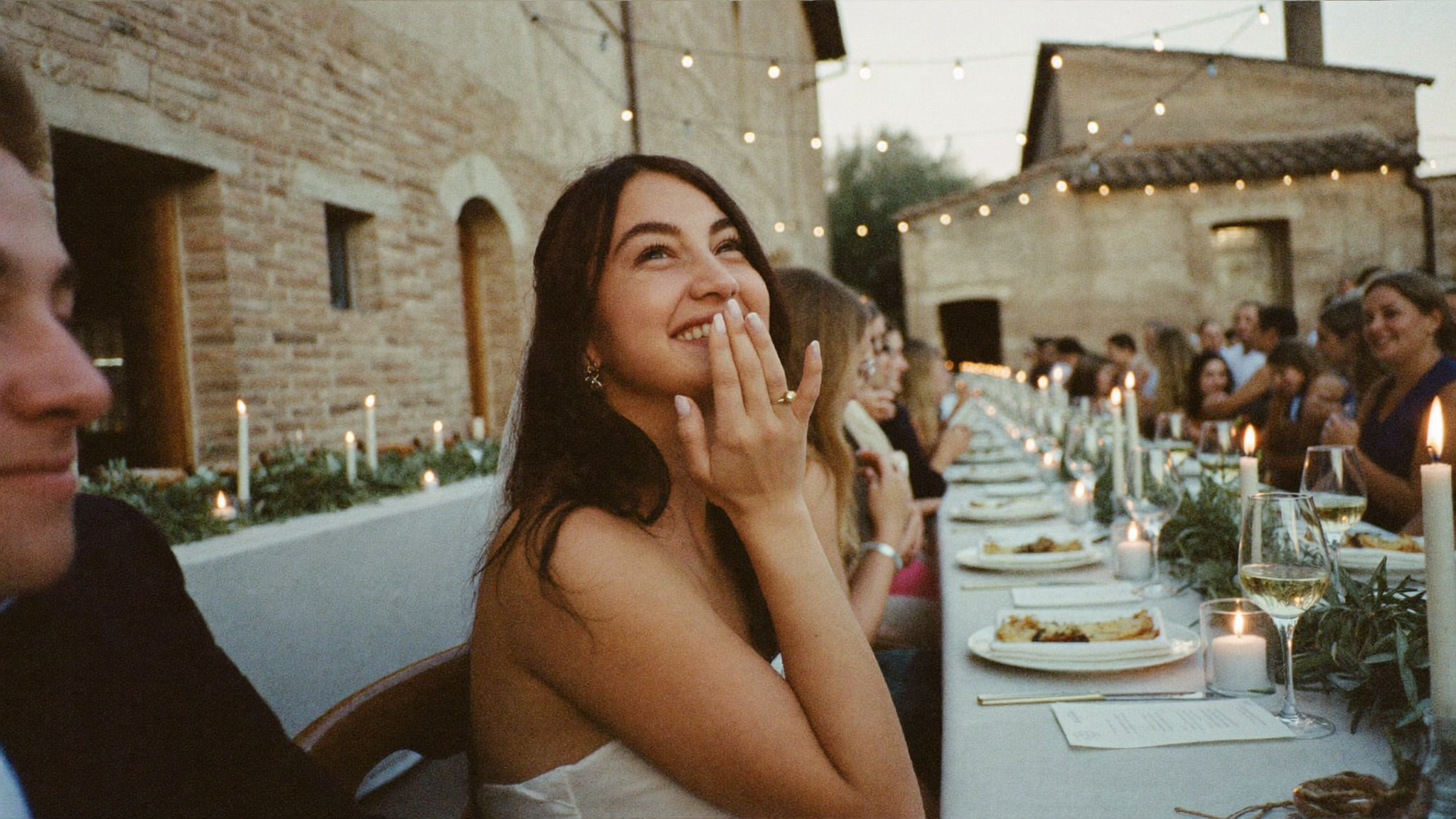
Six percent. That is our own rough estimate of the share of a wedding day one camera can realistically cover, not a published statistic, just the number we keep landing on after watching enough weddings unfold from setup to morning-after gallery. Not because the photographer is bad. Because there is one of them, and the day is roughly nine hours of dozens of small, overlapping moments happening in different rooms at once. The math has nothing to do with skill.
The other ninety-four percent is happening somewhere else at any given time. The table behind the photographer. The corner of the venue they are not in. The bar where the toast is being told again, better this time. The hallway where an aunt is fixing the bride's veil before anyone notices it slipped. Different rooms, different cameras, different people. None of it in the gallery, because the gallery can only hold what the lens was pointed at.
This is a math problem, not a photographer problem. Anyone you hire, however good, sits inside the same constraint. A single photographer occupies a single point in space. So the real question is not which photographer you pick, or how many hours you book them for. It is whether you have a plan for the other ninety-four percent, or whether you leave it to chance and hope someone remembers to text you their camera roll.
What a photographer is actually for
To be clear about what the 6 percent covers, because it is not a small thing: the first kiss, the vows read at exactly the right distance and light, the formal portraits with the whole family arranged and looking the right direction at the same moment, the cake cutting, the golden-hour couple shoot that requires a specific location and twenty minutes of uninterrupted time. That work takes years of skill to do well. A guest with a phone cannot replicate directed portrait lighting, a second shooter positioned for the aisle reaction shot, or a curated final edit. Nobody is arguing the photographer is replaceable for that list.
The issue is that this list is, by design, a small and deliberately framed slice of a much longer day. A wedding photographer builds a shot list and a timeline precisely because they cannot cover everything, so they cover the moments that are plannable: the ones with a known time, a known location, and enough advance notice to set up the shot. Everything else, the unplannable 94 percent, was never going to make that list because it cannot be scheduled.
- Ceremony reactions from anywhere but the front row. The photographer is usually positioned for the couple and the officiant, not for the guest three rows back whose face changes when the vows land.
- The toast, told again at the bar an hour later. The version guests actually remember is rarely the formal one captured mid-speech.
- Parking lot and hallway moments. Veil fixes, shoe changes, a sibling crying alone for a second before composing themselves.
- Kids running their own parallel wedding. Flower girls asleep on chairs, ring bearers stealing cake, none of it on any shot list.
- Everything after the contracted hours end. Most photography packages stop around ten or eleven at night. The midnight dance floor and the after-party do not.
A quick note on that number: it is not a cited study, and we are not pretending it is. It is the estimate we have arrived at ourselves, watching wedding after wedding, comparing what a contracted photographer delivers against what actually happened in the room. Treat it the way you would treat any illustrative rule of thumb, useful for thinking about the gap, not a scientific measurement of your specific wedding.
If the math made the case for you, see how the 94 percent gets captured.
What every couple tries first
Most couples do one of three things to try to capture everything else, before they realize none of the three actually work.
The pitch: put a tag on the welcome sign, and every guest's post rolls up in one feed automatically.
The reality: barely anyone uses them. A small fraction of guests ever post, and the photos that do go up are buried in feeds within a day.
What happens after: by the time the honeymoon is over, the tag is effectively dead, and nobody is going back to scroll through it looking for photos.
The pitch: a charming, low-tech way to get candid film shots from every table.
The reality: a large share are never developed. The ones that do come back are mostly blurry and flash-blasted.
What happens after: the usable shots end up a small fraction of what was spent on the cameras and the film processing, weeks after the wedding.
The pitch: a simple group text after the wedding, everyone just forwards what they took.
The reality: this is the saddest one. Couples text the same group chat for three months, and the requests eventually just stop.
What happens after: they get back maybe a small fraction of what was actually taken, at compressed, degraded quality.
None of these work, and it is worth being honest about why, because the reason matters more than the failure itself. Every one of them relies on a guest remembering to do something extra, days or weeks after the moment has already faded from their mind. The math does not change just because the couple wants it to. The 94 percent stays trapped on dozens of different phones.
Where the gap shows up, hour by hour
It helps to walk the timeline of an actual wedding day and mark where a photographer is present and where they physically cannot be, because the pattern repeats at almost every wedding regardless of budget.
Getting ready.
The photographer is typically with the bride or the groom, not both. Whatever is happening in the other room, a nervous joke, a parent's toast before anyone has even left for the venue, is missed by the lens entirely.
The ceremony itself.
Coverage is strong here, but narrow. The photographer is positioned for the couple and the officiant. The guest three rows back whose face changes when the vows land is almost never in frame.
Cocktail hour.
This is usually when formal portraits happen, which means the photographer is occupied with the bridal party while the rest of the guest list mingles, unphotographed, for forty-five minutes to an hour.
Dinner and toasts.
The formal toast gets captured. The version guests actually retell later, at the bar an hour afterward, does not, because the photographer has moved on to the next item on the timeline.
First dance and open dance floor.
The first dance is covered closely. Once the floor opens to everyone, coverage thins fast, one camera cannot track forty people moving at once across a dark room.
After the photographer leaves.
Most contracts end around ten or eleven at night. The midnight dance floor, the after-party at the bar, the long table outside at one in the morning, all of it happens in the hours nobody hired coverage for.
The handoff problem
Guest photos do not disappear because guests do not care. They disappear because of a handoff that never happens. A guest takes a great photo. In the moment, they intend to send it. Then the night continues, the DJ starts a new song, someone hands them a drink, and the intention evaporates. By the next morning the photo is one of six hundred on their camera roll, indistinguishable from vacation shots and screenshots, and it will likely never surface again unless the couple asks directly, which most couples are too polite or too busy to do more than once.
Even when guests do try to send photos, the tools work against quality. Group texts compress images down to a fraction of their original resolution. Messaging apps re-encode video into something blurry and pixelated. A guest forwards a photo through three different apps before it reaches the couple, and by the third hop it looks nothing like what the camera originally captured. Our detailed breakdown of this exact failure mode is in 8 wedding photo regrets, which walks through the specific moments couples say they wish they had.
The fix for a handoff problem is never "ask harder." It is removing the handoff entirely, giving guests one obvious place to put a photo the second they take it, before the night moves on and the intention fades. That is the entire mechanism behind a QR code on every table: it turns a multi-step favor into a five-second action a guest completes while the moment is still fresh in their mind.
The couples who solved it
Across the pix.wedding weddings we have watched go from setup to morning-after, the pattern is consistent. When a QR card sits on every table, most guests who wanted to share a photo actually share several. Photos arrive in original quality, never compressed by a messaging app. The couple has them within a day. No app, no logins, no friction, and no need to chase anyone for a week afterward. Our piece on two kinds of couples looks at the split between the ones who plan for this in advance and the ones who find out about the gap the hard way.
Couples are walking away with everything the photographer cannot reach. The dance floor at midnight. The grandparents at table six, mid-story. The flower girl asleep on a chair at the back. It all lands in one private album, theirs the morning after, at full resolution, sorted by time so the story of the night is still intact. If you want to know which single photo tends to matter most once the dust settles, we wrote about that specifically in the one photo you will look for.
Before landing on this approach, most of these same couples had already tried the group chat, the hashtag, or a shared cloud folder that nobody remembered the link to. If you have tried any of those and want to see exactly why each one fails under real conditions, our teardown in 5 wedding photo solutions that don't work covers the mechanics in detail. The short version is the same lesson every time: a solution that depends on guest memory loses to one that removes the need for memory entirely.
Whatever guests happen to send back arrives late, compressed by three different apps, and scattered across texts nobody can search through again.
Every guest photo lands in one private album, full resolution, sorted by time, ready the morning after the wedding ends.
The cost of waiting
The reason this decision gets skipped is not that couples do not care. It is that it does not feel urgent while planning. The dress fitting has a deadline. The venue deposit has a deadline. "Figure out how guests will share photos" does not feel like it has one, so it slides to the bottom of the list, and often falls off entirely once the invitations, the seating chart, and the final headcount eat the last few weeks before the wedding.
The trouble is that the deadline is real, it is just invisible. Once the ceremony starts, there is no way to retroactively give three hundred guests a place to put their photos. Whatever system is in place, or is not, at the moment the first guest takes a candid shot is the system for the entire night. There is no second setup window once the first dance starts.
The couples who plan for it treat it the same way they treat the seating chart: a small, finite task with a hard deadline, done a few weeks out and then forgotten about until the photos start arriving. The couples who do not tend to discover the gap the week after the wedding, when they realize the gallery from the photographer is beautiful and complete, and also a small fraction of everything that actually happened that day.
What this is not
To be direct about the limits of the argument here: this is not a claim that guest photos are somehow better than professional ones, or that a QR card is a replacement for a skilled photographer's eye. It is not a study, and the 6 percent figure is our own working estimate, not a number pulled from research. It is a plan for the part of the day a single photographer was never going to reach in the first place, no matter how good they are.
The one decision that closes the gap
The fix is not complicated, and that is part of why it works. It is a single decision, made a few weeks before the wedding, that does not touch the photographer contract, the budget for flowers, or anything else on the planning checklist. Our full walkthrough at how to collect photos from wedding guests covers the setup step by step, but the shape of it is simple: put a QR code on every table, plus one at the entrance and one near the bar, so guests see it early and repeatedly through the night.
A guest scans the code with their phone camera, no app required. The link opens a browser upload page. They upload the photo they just took, or several, directly from their camera roll. There is no account to create and nothing to remember later. The full mechanics of why this specific format (a physical code, not a digital link shared in a group chat) outperforms every other method are in our guide to the QR code for wedding pictures approach.
Every photo lands in one private album that only the couple controls, visible to no one else unless they choose to share it. Wedding photo sharing built this way removes the two things that kill every other method: the extra step a guest has to remember, and the compression that ruins photo quality when they get forwarded through three different messaging apps.
Four objections, answered
Before dismissing this as one more thing to plan, it is worth running through the objections couples actually raise, because most of them fall apart under a second look.
The objection: a strong photographer feels like insurance against missing anything important.
Why it does not hold up: skill changes how good the 6 percent looks. It does not change the fact that it is still one camera in one place. The two problems are unrelated.
The objection: the guest list skews older, or the couple assumes few people will bother taking photos at all.
Why it does not hold up: a scan-to-upload QR code needs nothing installed and works on any phone with a camera, which covers effectively every guest regardless of age or tech comfort.
The objection: it feels free and requires no advance setup.
Why it does not hold up: covered above, this is the handoff problem in its purest form. It relies on memory weeks after the moment, and memory is exactly what fails.
The objection: the final weeks before a wedding are already full of small tasks.
Why it does not hold up: the setup is a five-minute task done once, printing and placing cards, compared with weeks of chasing photos afterward that never fully arrive.
Terms worth knowing
- Coverage. The portion of a wedding day a photographer or camera physically captures. A contracted photographer's coverage is the 6 percent; everything else is uncovered by default.
- The handoff problem. The gap between a guest taking a photo and that photo actually reaching the couple, where most guest photos quietly disappear.
- Compression loss. The quality a photo loses each time it passes through a messaging app that re-encodes it, which is why forwarded photos look worse than the original.
- Participation friction. Any extra step, an app download, an account, a login, that a guest has to complete before they can share a photo. Every extra step loses participants.
- A shared destination. One agreed place, like a QR-linked album, where every guest photo lands automatically, removing the need for anyone to remember to send anything.
- Golden-hour window. The narrow stretch of soft light photographers rely on for couple portraits, one more reason the photographer's schedule is tight and cannot flex to cover everything else too.
Our honest recommendation
Book the photographer. Absolutely. The first kiss, the vows, the portraits, the cake, that work is irreplaceable, and pix.wedding does not replace it and was never built to.
But the math does not change. One photographer cannot be everywhere at once. So plan for the 94 percent too. Put a QR card on every table, and let the people standing in those other rooms hand you what they saw, in the same quality they captured it, without you having to ask twice.
A five-minute setup checklist
If the math has made the case, the actual setup is short. Here is the entire list, done once, a few weeks before the wedding.
Pick the destination.
Choose the private album guest photos will land in, before anything gets printed, so the QR code links to a real, ready destination on the wedding day.
Print one card per table.
Plus one near the entrance and one by the bar, so guests see it early in the night and again later, not just once during the toasts.
Say it out loud, once.
A short mention from the DJ or officiant, "scan the card on your table to share your photos," does more than any sign alone.
Check the album the next morning.
This is the part that used to be a chore, chasing texts for weeks. Now it is a single visit to one place, already sorted and waiting.
One practical note worth planning around: venues with weak cell signal or spotty wifi in the reception hall can slow uploads. If the venue is remote or has thick stone walls, ask about guest wifi in advance and mention the network name on the card itself, so a guest is not standing outside trying to get a signal at the exact moment they wanted to upload the photo they just took.
A second note: because every upload goes straight to the album rather than sitting on a single guest's phone, a lost phone, a dead battery, or someone deleting their camera roll after the honeymoon no longer means a photo is gone for good. The moment it uploads, it is safely out of any one person's hands.
Why this still matters a year later
The value of this is not obvious on the wedding day itself, when the photographer's gallery has not even been delivered yet and everything still feels covered. It shows up later, on the first anniversary, or the year after, when the couple wants to look back and the professional gallery, however beautiful, tells only the framed version of the story. The 94 percent is where the unscripted parts of the day live: the exact moment a parent's face changed, the joke that made the whole table laugh, the ten seconds after the ceremony before anyone had composed themselves again.
A year later, nobody is disappointed by having too many photos of their wedding. The couples who set up a shared destination for guest photos are the ones who can hand a grandchild a phone one day and scroll through a version of the day that a single camera, however skillfully operated, was never able to capture on its own.
Questions couples ask
Does hiring a better photographer solve the 94 percent problem?
No. A more skilled photographer will get more out of their 6 percent, sharper portraits, better light, tighter timing. But the constraint is not skill, it is position. One photographer is in one place at a time. The other 94 percent is a coverage problem, not a talent problem, and no amount of hiring solves a coverage problem by itself.
Where do the missing photos actually end up?
On guest phones, almost entirely. A cousin catches the reaction during the vows. A friend gets the toast on video. Someone snaps the dance floor at midnight after the photographer has packed up. All of it exists. Almost none of it reaches the couple, because it sits in dozens of separate camera rolls with no shared destination.
Is the 6 percent figure an official statistic?
No, and we want to be direct about that. It is not a cited study or a published survey number. It is our own rough, illustrative estimate, the kind you arrive at after watching enough wedding days unfold from setup to morning-after gallery delivery. Treat it as a way to think about the coverage gap, not as a scientific measurement.
What is the simplest way to collect guest photos without an app?
A QR code on every table that opens a browser upload page, no app download and no account creation for guests. They scan, they upload from their existing camera roll or take a new photo, and it lands in one private album the couple controls. That removes the two biggest reasons guest photos never get shared: friction and no clear place to send them.
When should we set up guest photo collection before the wedding?
A few weeks out is plenty. It takes about five minutes to set up a QR card system, and the only real task is printing the cards and placing one per table (plus one near the entrance and one by the bar) so every guest sees it early in the night rather than discovering it after the good moments already happened.
Does a guest photo QR code replace the photographer?
No, and it is not meant to. The photographer still owns the 6 percent: the first kiss, the vows, the formal portraits, the cake cutting. Those shots need direction, timing, and equipment a phone cannot replicate. The QR code exists for everything the photographer physically cannot be present for at the same time.
What changes now
Photographers will keep showing up to weddings. They will keep doing the 6 percent they do brilliantly: the first kiss, the vows, the staged portraits, the cake. That work matters, and no couple should skip it to save money on a QR card.
The rest of the day matters too, and it has always been the part that quietly slipped through. Until now it stayed on dozens of phones because there was nothing to catch it. There is now, and setting it up takes less time than picking a font for the invitations.
Your wedding will go by in a blur. The photos do not have to.
Six percent, ninety-four percent, one album. That is the whole idea.